A Simple Beginner’s Guide:
Quartz vs. Automatic Watches
When you first start exploring the world of fine watches, the very first choice you will encounter isn’t about style, pricing, or brands. It’s about what ticks inside. This internal mechanism is called the movement, often referred to as the “soul” of the timepiece.
For beginners, movements generally fall into two main categories: Quartz and Automatic. Let’s break down exactly what they mean in plain, simple terms so you can choose the perfect fit for your wrist.
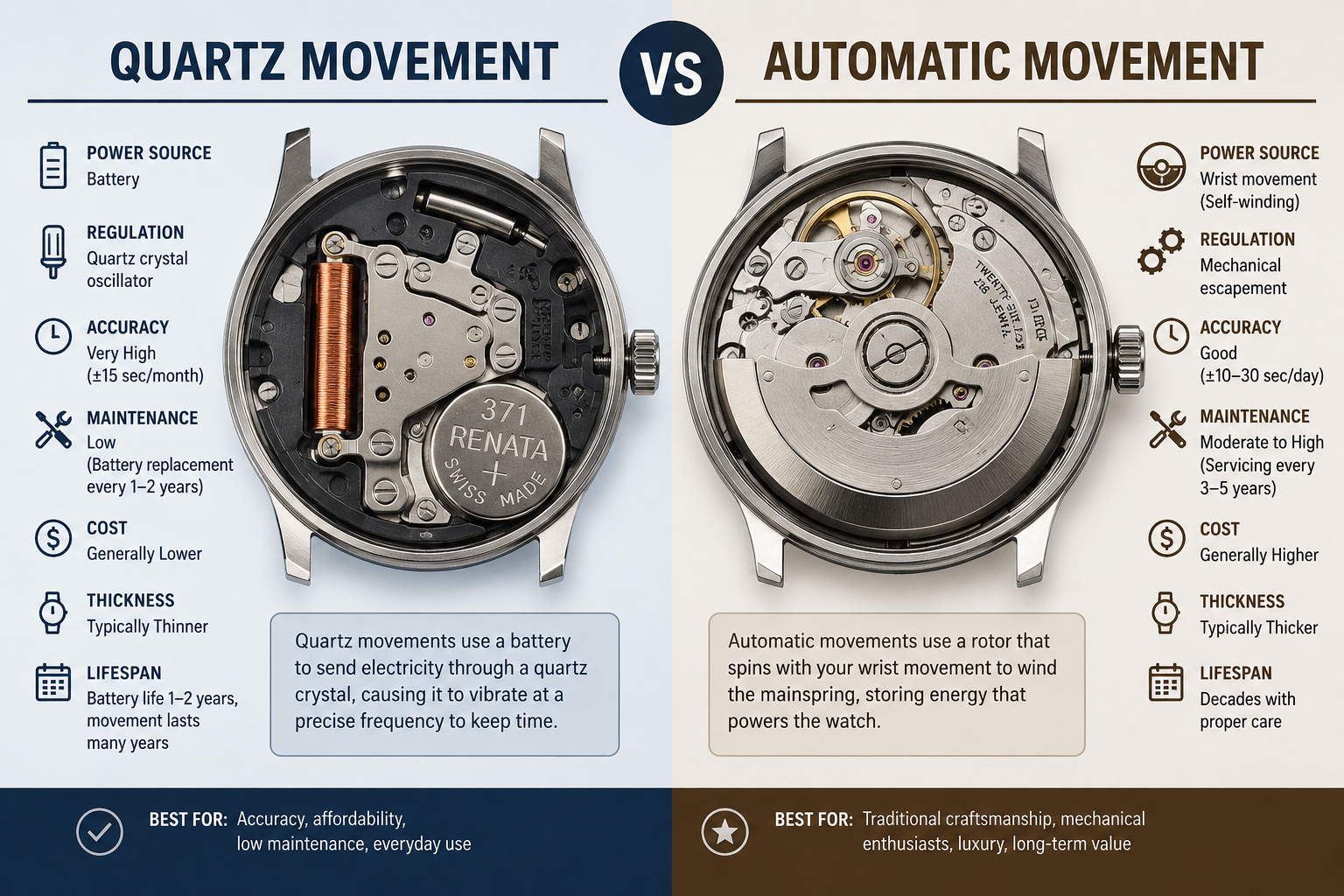
1. Quartz Watches: Battery-Powered Precision
Introduced in the late 20th century, quartz movements completely revolutionized how the world tracks time. They are powered by a small electrical battery that sends a current through a tiny, synthetic quartz crystal.
When electricity hits the crystal, it vibrates at a hyper-precise frequency of exactly 32,768 times per second. The watch’s internal microchip counts these regular vibrations and translates them into exactly one hand movement per second.
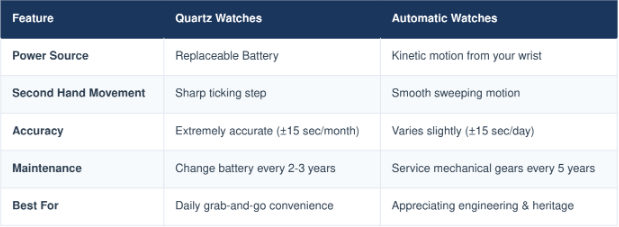
• How to spot it on your wrist: Look closely at the second hand. If it moves with a distinct, sharp “tick… tick… tick…” pause once every second, it is a quartz watch.
• The Main Benefit: Incredible accuracy and convenience. A standard quartz watch loses or gains only a few seconds per month, requiring zero daily attention other than a quick battery swap every 2 to 3 years.
2. Automatic Watches: The Mechanical Soul
An automatic watch does not contain a single battery, microchip, or electrical circuit. Instead, it runs on pure, intricate mechanical engineering. It is powered by a tightly coiled spring (called a mainspring) hidden deep inside the watch gears, which slowly releases its stored tension to turn the hands.
Why is it called “automatic”? Inside the back of the watch case sits a free-spinning, weighted metal semi-circle called a rotor. As you move your arm naturally throughout the day, this rotor spins and automatically winds the internal spring for you. As long as you wear it regularly, it keeps running indefinitely.
• How to spot it on your wrist: Watch the second hand closely. Instead of ticking rigidly every second, it glides across the dial face in a fluid, elegant sweeping motion.
• The Main Benefit: Craftsmanship and heritage. Mechanical automatic watches are appreciated worldwide as miniature works of kinetic art, offering a connection to centuries of classic watchmaking tradition.
Quick Tip for First-Time Buyers
If you leave an automatic watch sitting on your nightstand for more than 40 hours, it will temporarily “fall asleep” and stop running because its spring has run out of tension. Don’t panic! This is completely normal. Simply turn the crown on the side a few times or wear it on your wrist to bring its mechanical soul right back to life.
Which One Should You Choose?
Your choice depends entirely on your lifestyle:
• If you want a hassle-free, highly precise watch that is always perfectly set and ready to go when you rush out the door, Quartz is your ideal daily companion.
• If you love the idea of wearing a living mechanical marvel that relies entirely on your body’s energy to run, an Automatic watch offers an emotional bond and standard of class that a battery simply can’t replace.