How to Wind an Automatic Watch the Proper Way
A widespread misperception is that automatic timepieces are just "set it and forget it." They are not perpetual motion machines, even if they do capture energy from your wrist's natural movement. The mainspring will unwind and the gears will stop if you leave your watch inside the drawer or a nightstand for a few days.
Knowing how to manually wind your watch is an important practice for any watch owner, whether you're waking up a sleeping vintage piece or making sure your daily wearer keeps perfect time.
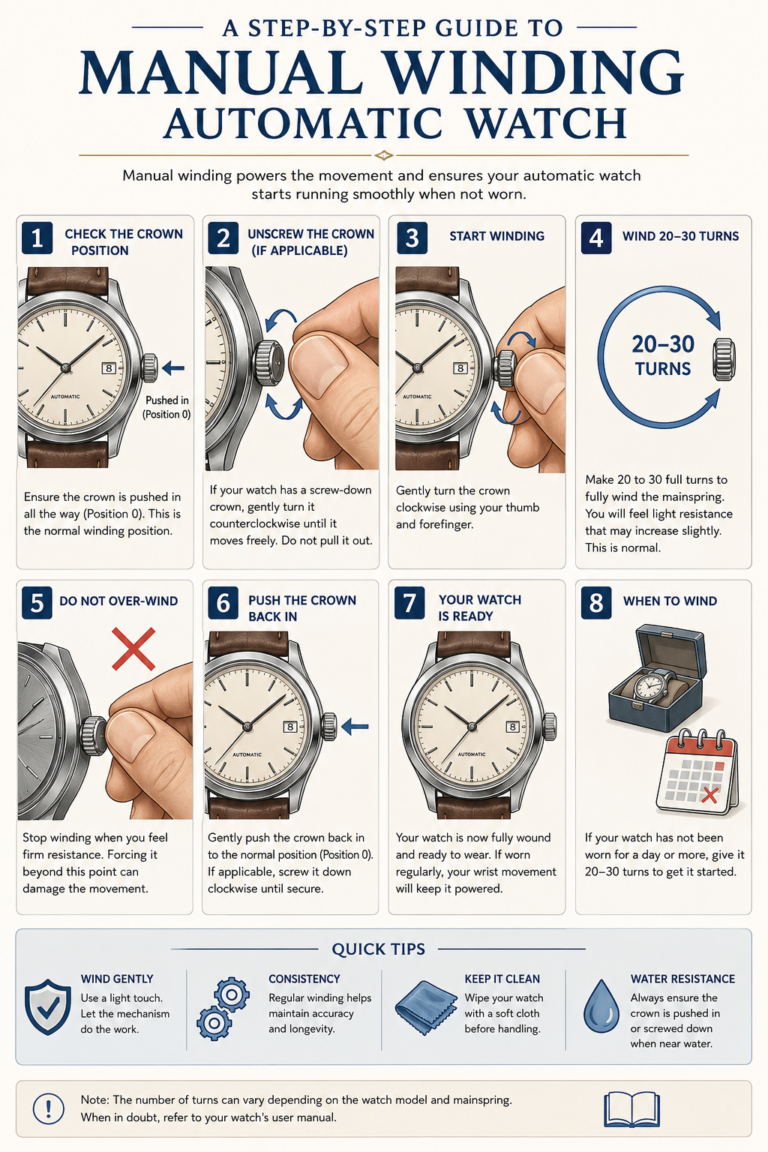
A Step by Step Guide to Manual Winding
Remove your watch off your wrist. If you wind your watch while wearing it, you might pull the stem upwards in a weird angle, which can easily bend or snap the delicate winding mechanism inside.
1. Identify Your Crown Type
• Standard Crown: Most dress watches are standard water resistance and the crown is already in the winding position. (Position 0)
• Screw-Down Crown: A dive watch or a sports model type, the crown is screwed tightly to seal out water. Gently turn the crown counter-clockwise (towards you) until it “pops” out slightly into its free- spinning winding position.
2. The 30-Turn Rule
Gently pinch the crown between your thumb and forefinger. Rotate it clockwise (away from you, or toward the 12 o'clock marker).
• You will feel a smooth, rhythmic clicking or slight resistance.
• Give it about 30 to 40 full rotations. This is more than enough to fully compress the mainspring and maximize its power reserve.
3. Can You Overwind It?
Fortunately, modern automatic watches feature a built-in safety mechanism called a “clutch”. Once the mainspring is fully wound, the clutch simply slips inside the barrel, preventing you from snapping the spring. Unlike vintage manual-wind timepieces, you might break it after 30-Turn! Gotta be careful folks!
4. Lock It Back Down
If your watch features a screw-down crown, gently push it back in while turning clockwise until it is snug. Do not force it too tight; a firm finger-tight seal is all it takes to keep the moisture out.